Overview
Overall 2023 was warmer than normal in the Bellcrest section of Toms River, NJ, and rainfall amounts were about normal for the 12 month period. However,as might be expected over the course of a year, there were variations in both temperature and rainfall that resulted in daily records being set. Rather than review each month specifically, the entirety of 2023 will be reviewed with respect to trends in temperatures, rainfall and thunderstorm days (which are new for this year with the acquisition of a new weather station capable of detecting lightning strikes, as well as their distance from the station).
Temperatures
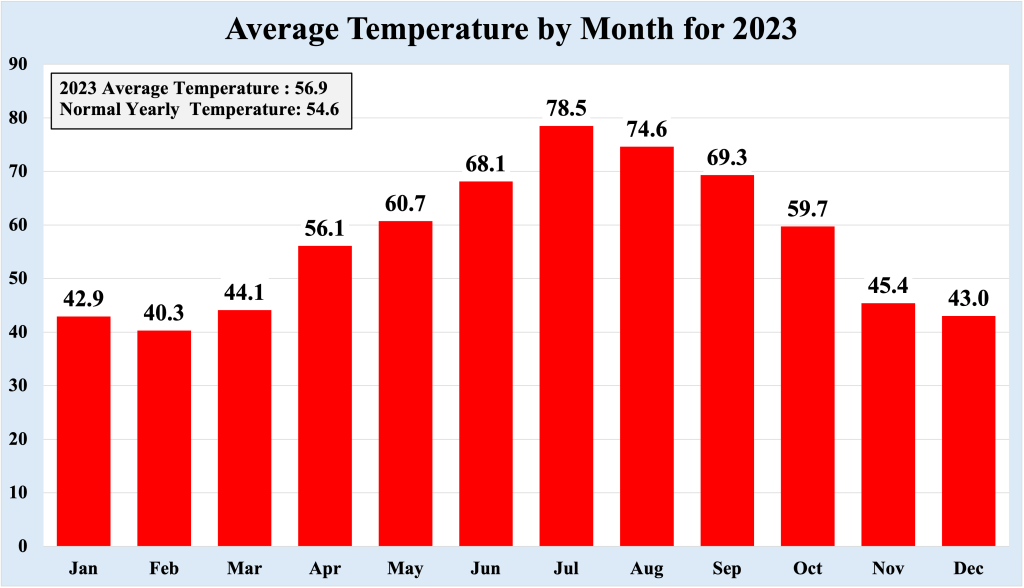
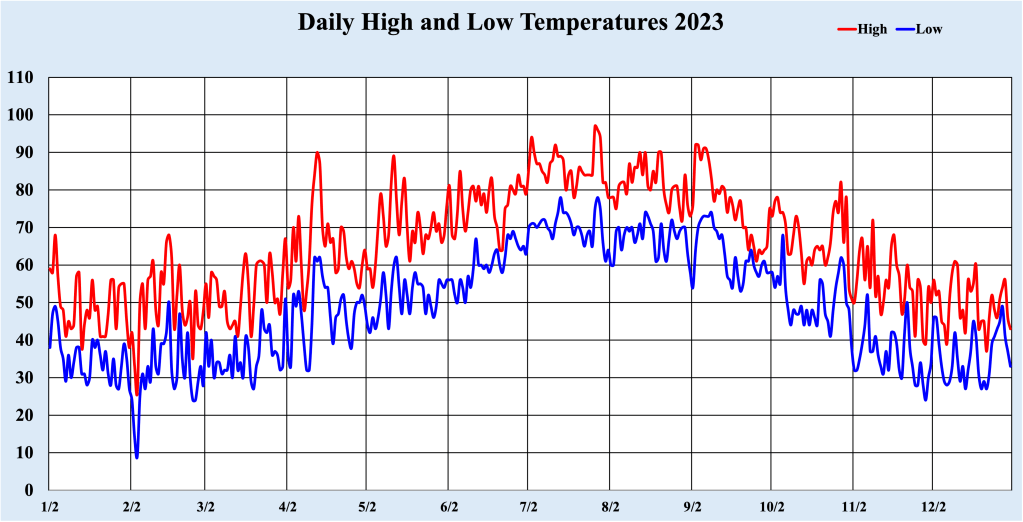
Warmer than normal temperatures began the new year, as January 2023 was the 10 degrees above normal. That impressive departure made January 2023 the second warmest January on record at this location (temperature records date back to 1978). In fact, the lowest daily temperature of the month was a mere 27 F, which is close to average low temperature for January. Warmth continued into February 2023, though the magnitude was not quite as impressive as January. Despite the warmer than normal conditions in February, the lowest daily temperature for the year occurred in early part of the month.
Meteorological winter (which includes December 2022/January 2023/February 2023) was above normal, despite slightly below normal temperatures in December, a testament to the warmth to the start of the new year. Above normal temperatures were experienced in March and April as well, with April 2023 being the warmest April on record for this location. During April, three record highs were established, including the second earliest 90 degree temperature.
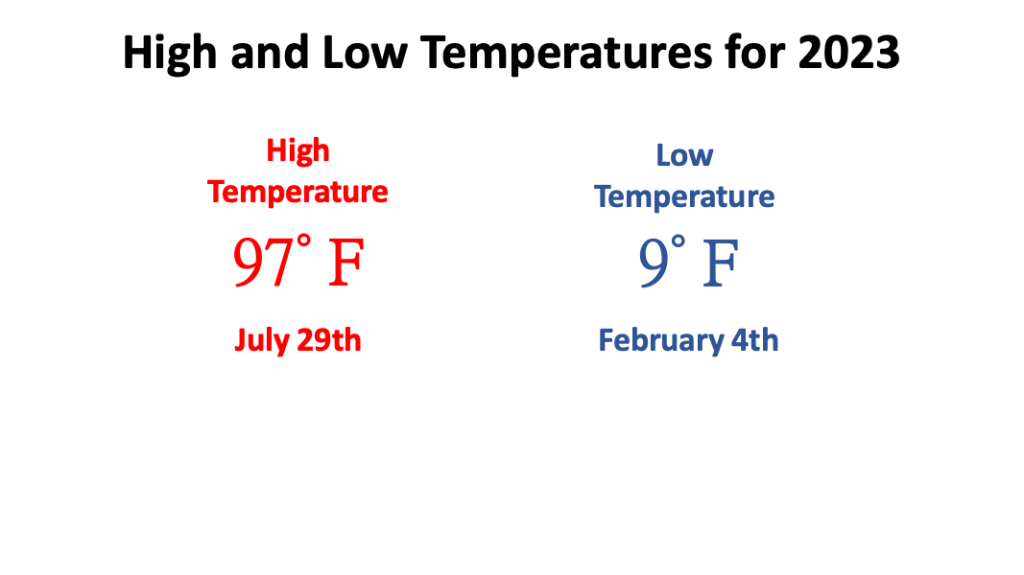
By contrast, late spring and early summer (May and June 2023) was cooler than normal. During this time, no record high or low temperatures were set, as the period was generally cool. July 2023 experienced warmer than normal temperatures, and the highest daily temperature of the year occurred on the 29th of the month. However, August 2023 was about normal with respect to temperature, meaning that the meteorological summer (June/July/August 2023) was essentially normal temperature wise, bucking a trend of warmer than normal summers over the past few years.
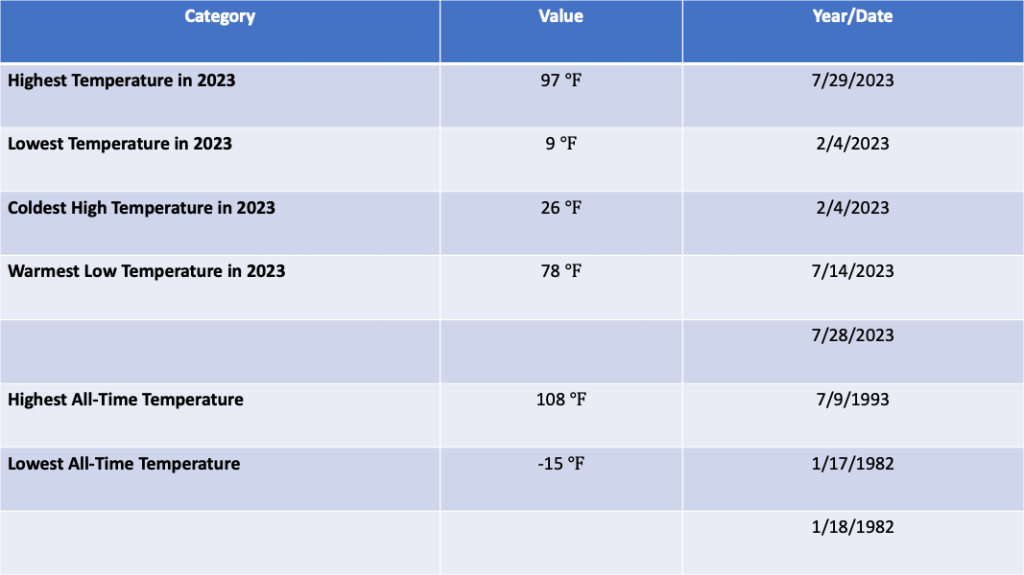
Warmer temperatures returned for meteorological fall (September/October/November 2023), especially during the first two months of that period. In fact, four daily record high temperatures were set in five days at the end of October, including a high of 82 degrees on the 28th, which rivals some of the highest temperatures this late into the season.
November 2023 was slightly below normal with respect to temperature, but December 2023 was much normal than warmer, ending the year as it began; with impressive warmth. In total, 13 daily record high temperatures were established during 2023, though they tended to occur in bunches (four in February, three in April, and four in October). This phenomenon makes sense from a meteorological perspective, as very warm and/or very cold periods tend to be stable, allowing these conditions to persist for a few days at a time. Amazingly, NO daily record low temperatures were set for the year, underlining the overall warmth of 2023.
Rainfall
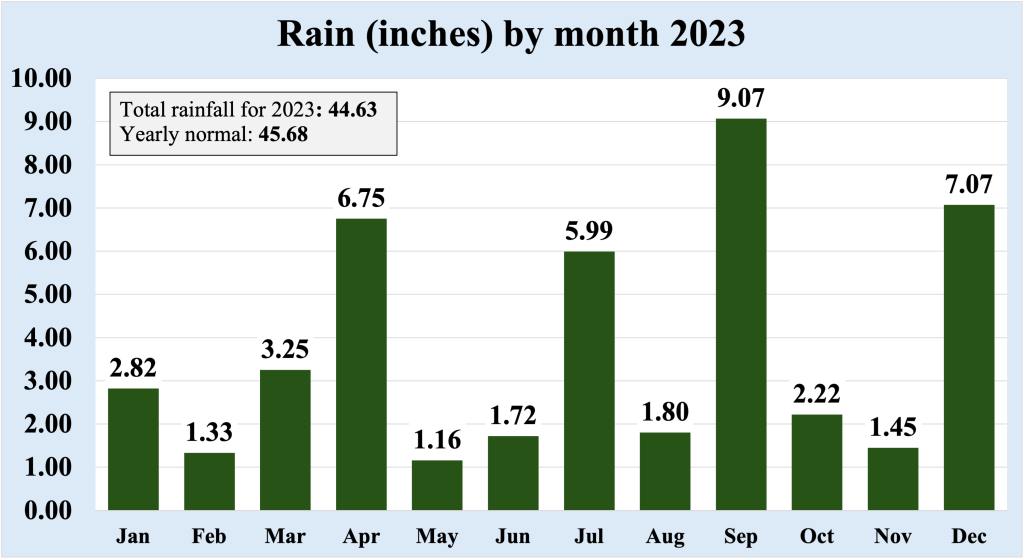
Overall, rainfall during 2023 in the Bellcrest section of Toms River, NJ was slightly below normal, but as is the case most years, there was quite a bit of variation from month to month. While January 2023 rainfall was about normal, rainfall during February 2023 was much below normal. The basic weather pattern during that month supported much above normal temperatures and displaced the normal winter storm track northwest of the Jersey Shore. Since the vast majority of rainfall (and snowfall, when it occurs) is associated with these winter storms, much drier conditions during February fits the overall pattern.
Rainfall in March 2023 was close to normal, but rainfall for April 2023 was record setting. Rainfall during a typical April is a combination of late winter like storms and the beginning of the convective season, when rainfall is much more dependent on the development of thunderstorms. During April 2023, the winter pattern broke down early, allowing warm and moist air to be drawn into the Mid Atlantic and Northeast states, feeding clusters of storms that affected the Jersey Shore, including Toms River. As a result, almost seven inches of rain fell during the month, meaning that April behaved more like a summer month than a spring month, with record warm temperatures and record rainfall.
During most years, rainfall during the summer and early fall is highly dependent on the development and track of thunderstorms. During a typical summer pattern, thunderstorms develop across eastern PA and western NJ during the afternoon, where both moisture and instability are in the greatest supply. As the storms move to the east or southeast toward the Jersey Shore, they tend to weaken, as the onshore flow ahead of the storms (on most days) tends to deplete instability, resulting in storms breaking up as they approach the coast.
Cooler temperatures during May and June 2023 meant that fewer storms survived their trek to the coast. May 2023 registered less than 1.25 inches of rain, which is only about one-third of what is normal. Dry conditions continued into June 2023, as the thunderstorm pattern favored locations away from the coast receiving the bulk of the rain for the month. Above normal temperatures during July 2023 supported more storms remaining intact as they reached the coast, resulting in nearly six inches of rain in Toms River. Cooler temperatures in August again supported less thunderstorm activity at the coast, resulting in another dry month.
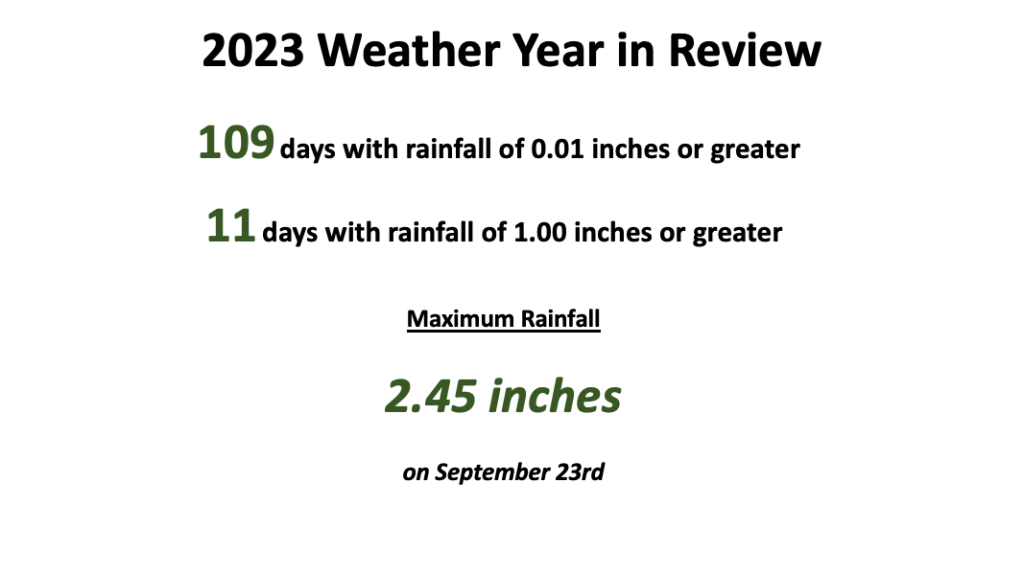
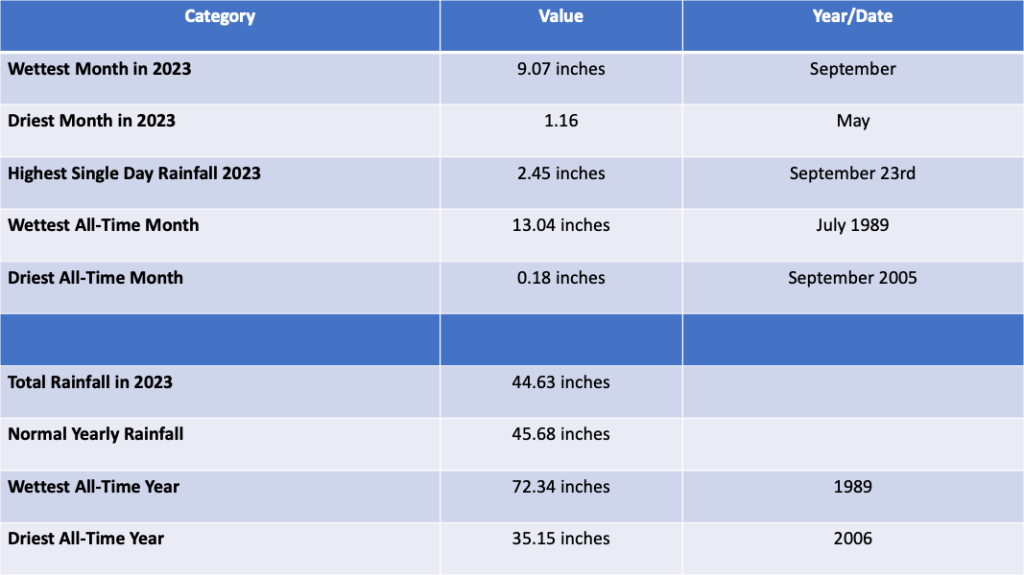
Thunderstorm season along the Jersey shore begins to wind down during August and September, as the weather pattern slowly changes from convective rainfall to rainfall associated with extratropical cyclones (winter storms). During September and the first half of October, thunderstorms become less likely, but the pattern does not yet support rainfall with winter storms. Unless moisture from decaying tropical systems affects the region, this time period can be quite dry. A weakening tropical storm drew deep moisture into Toms River during the last week of the September 2023, producing back to back rainfall events that dropped five inches of rain across the region. In total, just over nine inches of rain was measured during September, resulting in the second wettest September on record at this location (rainfall records extend back to 1989).
November 2023 was much drier than normal, as the usual storm track for winter storm rainfall had not yet become established. However, December 2023 saw the return of the winter storm like systems. but almost all of these systems tracked to the west of NJ, meaning that the coldest air was trapped well northwest of the area, resulting in rain instead of snow. December 2023 saw just over seven inches of rain, which is almost double what is expected in Toms River. So, while the 2023 yearly rainfall was basically normal, large variations in the month to month rainfall amounts were tied directly to the availability of moisture during the warmer than normal year.
Thunderstorms
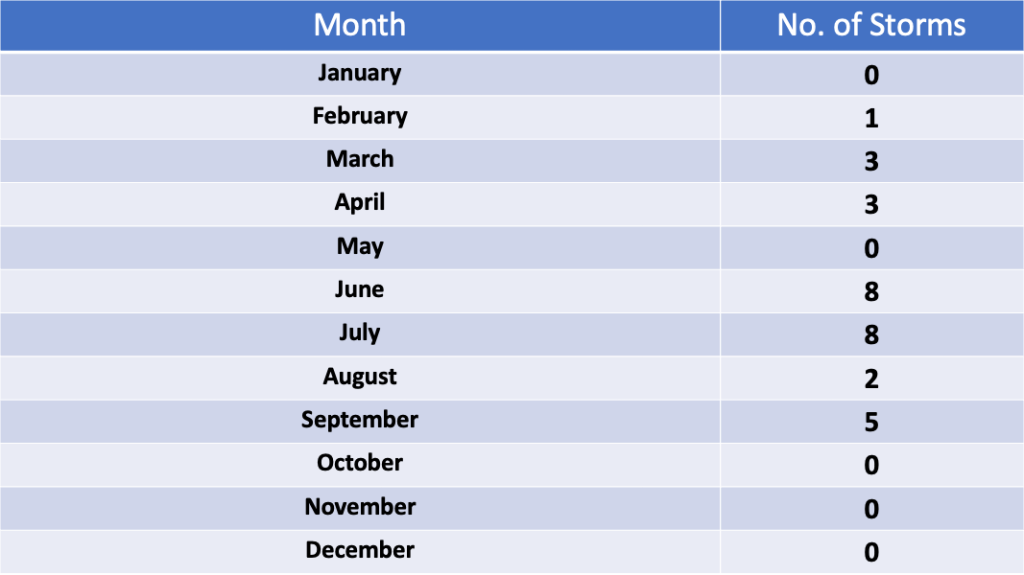
Table 5 Number of thunderstorms detected in Toms River, NJ by month during 2023.
With the acquisition of a weather station capable of detecting the occurrence of lightning at the end of 2022, we are capable of detecting lightning strikes with about 25 miles of the station. So far, the accuracy of the lightning detection system appears to be excellent, at least when compared to the lightning sensor aboard the GOES-16 satellite (you can check out the GOES Lightning Mapper output here).
We have been logging the number of days with lightning five miles or closer to our location (a proxy for a thunderstorm day, as that is the distance at which airports report thunderstorms). Strikes are plotted as small rectangles on a background which shows distance of the strikes from the sensor and the time the strikes was recorded.
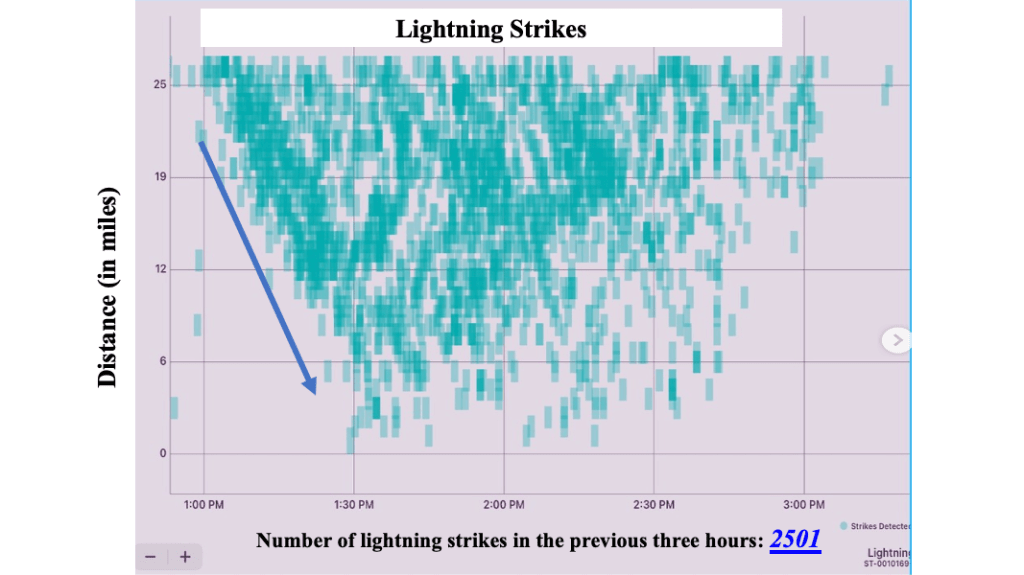
Unfortunately, there are no comprehensive collections of lightning strikes readily available for the Jersey shore, so the results we documented this year do not have any context. As might be expected, January and February 2023 accounted for one thunderstorm day between them, but March and April had three each. While it is unknown if this a significant number of thunderstorm days for either month, the weather pattern did support thunderstorms during this period. Cooler than normal conditions yielded no thunderstorm days in May 2023. which seems to be an anomaly, as May often marks the beginning of thunderstorm season near the shore.
June and July 2023 each had eight thunderstorm days, which makes meteorological sense, as these month comprise the heart of thunderstorm season for the Jersey Shore. The number of storm days dwindled in August and September, and no thunderstorm days were logged for the remainder of 2023. Again, without some type of thunderstorm climatology, it is difficult to gauge whether the thunderstorm day numbers are indicative of a “normal” thunderstorm season, but we are excited at the possibility of building one going forward.
Review
Overall 2023 was warmer than normal in the Bellcrest section of Toms River, NJ, and rainfall amounts were close to normal during that period. However, as might be expected over the course of a year, there were variations in both temperature and rainfall that resulted in daily records being set throughout the year. Nine of the 12 months of 2023 experienced warmer than normal temperatures, with April being the warmest April on record, and January was the second warmest January at this location.
While the yearly rainfall was close to normal, April 2023 was the wettest April on record, and September was the second wettest September on record. Finally. purchasing a new weather station with a lightning sensor allowed us to measure the number of days with thunderstorms within five miles of the station. For now, the representativeness of the number of thunderstorms days is unknown, but we plan to build our own thunderstorm climatology for Toms River.
 NJ Weather Info
Leave a comment