In contrast to the rest of the Northern Hemisphere, meteorologists consider fall to stretch from September 1st to November 30th, inclusive. This is done primarily to make calculations of parameters simpler and more consistent (as the first day of each season can vary slightly, resulting in difficulties comparing seasonal averages). During meteorological fall, conditions can range from summerlike in September to winterlike in late November, making it more dynamic than any other season. Meteorological fall in 2023 was no different, as September heat gradually faded into winter cold near the end of November.
Temperatures
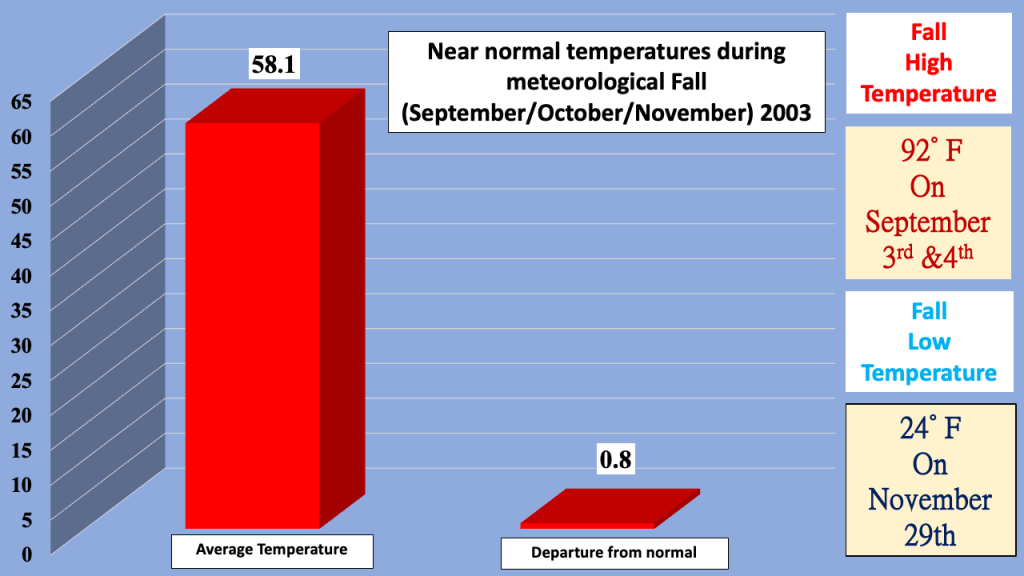
Overall, temperatures for the meteorological fall averaged just under a degree above normal. The largest departure from normal occurred during October, which was 2.7 degree above normal for the month. Late October was particularly warm, when four new record highs were established in the final five days of the month (October 26th, 27th, 28th and 30th). High pressure anchored off the Mid Atlantic and Southeast US coasts pumped unseasonable warmth into NJ, with the highest temperature of the month recorded on the 28th (82 degrees). By contrast, November 2023 was below normal. Large temperature swings were noted during the month, with winterlike conditions settling into the region at the end of the month. The lowest temperature during November was 24 degrees on the 29th, and while that seems quite cold, the record low temperature for November is actually 14 degrees, most recently happening on November 23rd 2018.
| Month | Avg Temp (degrees F) | Normal | Departure | Rainfall (Inches) | Normal | Departure |
| Sep | 69.3 | 67.9 | +1.4 | 9.07 | 3.81 | +5.26 |
| Oct | 59.7 | 57.0 | +2.7 | 2.22 | 4.14 | -1.78 |
| Nov | 45.4 | 46.9 | -1.5 | 1.45 | 3.15 | -1.70 |
Rainfall
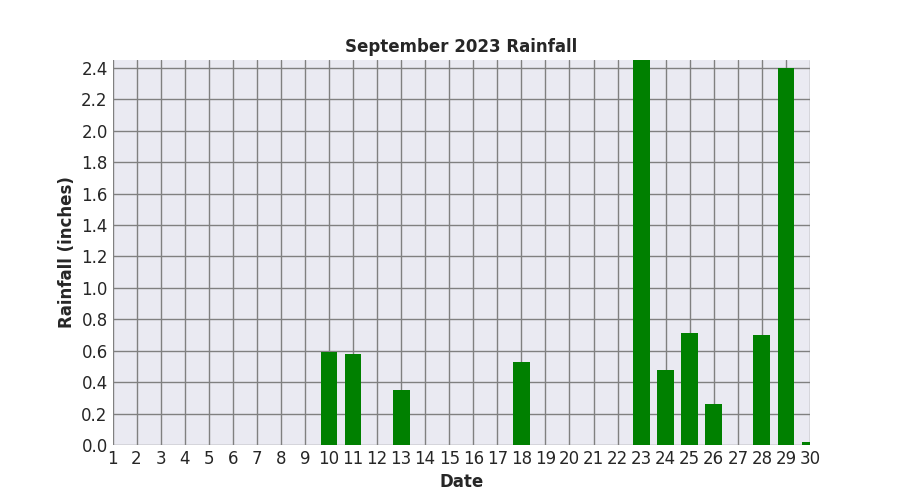
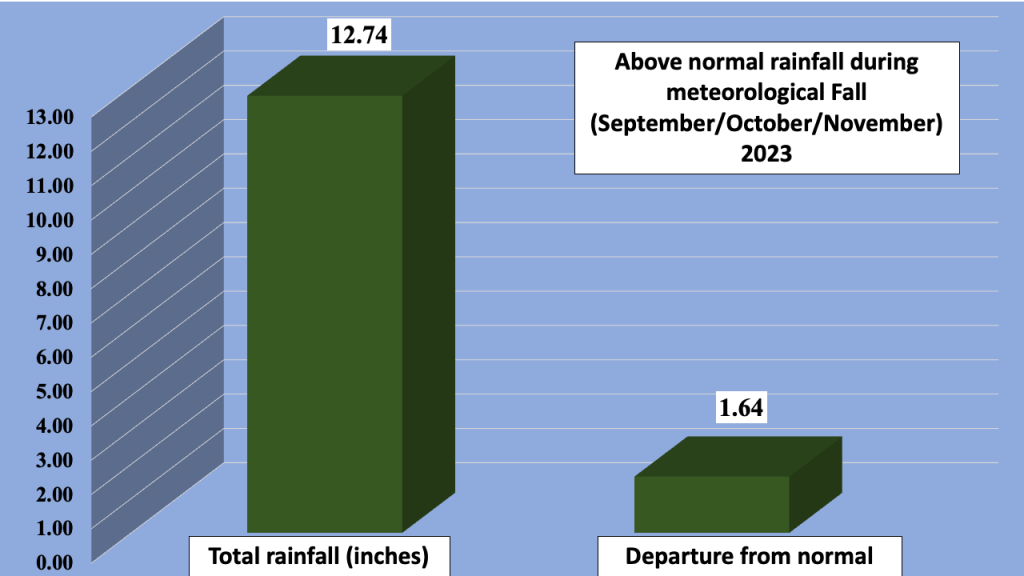
Though the rainfall for meteorological fall averaged above normal, near record rainfall in September was contrasted by a record dryness in November. September 2023 began with near normal rainfall, but this changed during the last eight days of the month, when over six inches of rain was recorded. Twice during this period more than two inches of rain were seen during a 24 hour period (the 23rd and the 29th). By the end of the month, the 9.07 inches of rain collected in the Bellcrest section of Toms River was the second highest September rainfall on record (rainfall records date back to 1989), bested only by the 9.35 inches of rain that fell during September 2012.
In stark contrast, both October and November 2023 had well below normal rainfall. Each month received less than half of the expected rain, and November 2023 was the 5th driest November on record. It is not usual for both months to be dry, as thunderstorm season generally ends in late August or the first half of September, and winter storms (often referred to as mid latitude cyclones) generally have not yet begun affecting the NJ shore. Occasionally moisture from decaying tropical storms can result in heavy rainfall (which occurred during early October 2022, as a dying Tropical Storm Ian infused moisture into a developing surface low, dropping more than six inches of rain during the first four days of the month in Toms River).
Thunderstorms
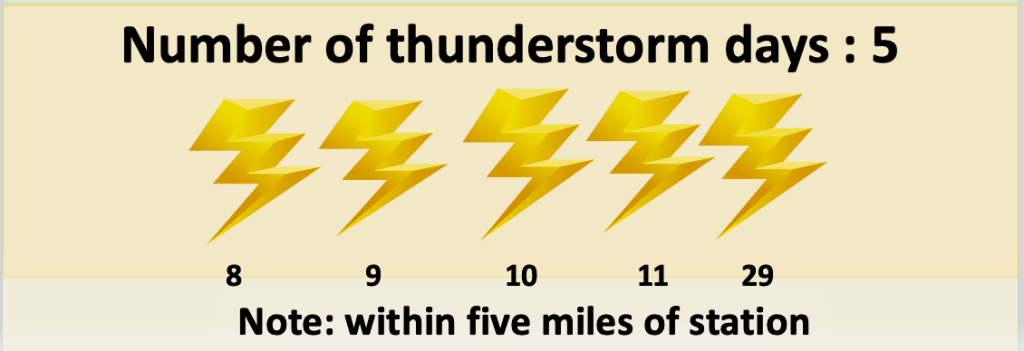
Our Tempest Weather Station has an onboard lightning detector, which allows us to log lightning activity within 25 miles of the sensor. For our purposes, a thunderstorm day happens when lightning is detected within five miles of the station. Only September 2023 experienced thunderstorms during the meteorological fall. During that month, thunderstorms were recorded on five days, mainly during the early and middle portion. Not surprisingly, both October and November did not have any thunderstorm days. Thunderstorms become increasingly rare during this months, but can occur, especially ahead of and along strong cold fronts.
Want to learn more about weather in the Bellcrest section of Toms River, NJ? We are building a website dedicated this very topic. Though it is still under construction, you can learn more about the climate of a location near the central NJ coast, with some data extending back into the late 1970s. Check it out here.
 NJ Weather Info
Leave a comment